

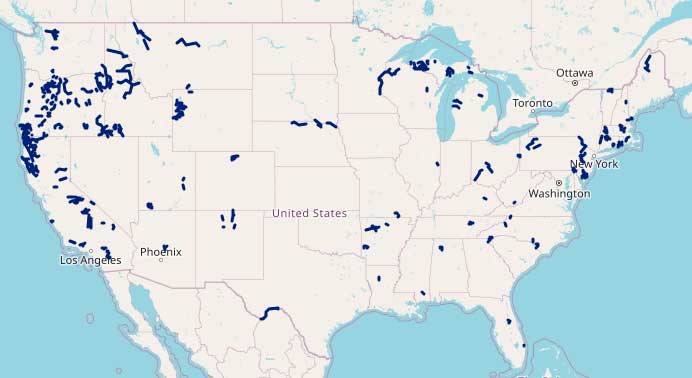
In 1968, the U.S. Congress passed the “National Wild and Scenic Rivers Act” which made it the policy of the United States that certain selected rivers of the nation, and their immediate environments, that possess outstandingly remarkable scenic, recreational, geologic, fish and wildlife, historic, cultural or other similar values, should be protected in free-flowing condition for the benefit and enjoyment of present and future generations. As of 2024 there are 228 designations spread across 41 states and Puerto Rico. Less than 0.25% of the Nation’s Rivers are designated as National Wild and Scenic Rivers.
Partnership Wild and Scenic Rivers
The Partnership Wild and Scenic River model has been used for over 30 years and was developed to meet the needs of rivers characterized by private land ownership and well-established local processes for governance and stewardship of river resources. For Partnership Wild and Scenic Rivers, communities protect their own outstanding rivers and river-related resources through a collaborative approach. A locally developed management plan must be in place. There currently are thirteen Partnership Wild and Scenic Rivers, primarily located in the northeast.
For a Partnership Wild and Scenic River Study, the suitability determination for designation includes factors such as (1) development of a non-regulatory, locally developed comprehensive management plan to protect watershed resources; (2) evidence of existing local resource protection measures, such as local ordinances, to protect river resources; and (3) public support by non-federal entities that will have a role in implementing a plan for protection.
How does a Wild and Scenic designation protect a river?
A Wild and Scenic designation protects the free and natural flow of a river and preserves what makes a river special. That includes:
- Safeguarding clean water
- Preventing activities that would significantly harm the river’s character
- Prohibiting new dams or damaging water projectsProtecting a quarter-mile buffer of land along Wild and Scenic Rivers flowing through public lands
- Requiring a management plan with input from local landowners and other stakeholders
The Wood-Pawcatuck: A Wild and Scenic River
In March 2019, after thousands of hours of community effort over a ten-year period, Rhode Island and eastern Connecticut residents celebrated the Wood-Pawcatuck Watershed receiving a National Wild and Scenic River designation. The watershed now joins less than 1% of the 3.6 million miles of streams designated as Partnership Wild and Scenic Rivers. Although Rhode Island is the smallest and the second most densely populated state in the union, a total of 110 river miles within this watershed were found to be eligible for this prestigious recognition and protection.
Learn more about the designation process.
How the Wood-Pawcatuck became a Wild and Scenic River.
For More Information:
NPS Partnership Wild and Scenic Rivers website
NPS Report (2016), Partnership Wild and Scenic Rivers – 20 Years of Success Protecting Nationally Significant River Resources through Locally Based Partnerships